
Most woodworkers know that when two boards meet at a 90-degree corner, cutting each board at 45 degrees creates a perfect miter joint.
But what happens when the boards aren’t the same width?
Suppose you’re building a woodworking project where a 3-inch-wide board needs to join a 5-inch-wide board at a 90-degree corner. You might assume that cutting both boards at 45 degrees will still work.
Unfortunately, it won’t give you the finished joint you’re looking for.
Although two 45-degree cuts can produce a 90-degree corner, the different board widths create a problem at the mating surfaces. The ends won’t line up properly, leaving an uneven interior corner.
The solution is to use two different miter angles.
You can determine those angles using a little trigonometry, or you can let a woodworking calculator do the work for you.
I’ll show you both methods.
Don’t want to do the math? Jump to the Easy Way!
Why 45-Degree Miters Don’t Work With Different Board Widths
When two boards have the same width and meet at a 90-degree corner, the miter line divides the corner evenly. Each board receives a 45-degree cut, and the mating surfaces match.
But when the boards are different widths, the situation changes.
Let’s use two boards:
- Board A: 3 inches wide
- Board B: 5 inches wide
- Finished corner angle: 90 degrees
If we cut both boards at 45 degrees, the angled mating surface on the 3-inch board will be shorter than the mating surface on the 5-inch board.
That means the cuts won’t match along their entire length.
You could line up one end of the joint, but the opposite end would be offset. The resulting interior corner wouldn’t have the clean, square appearance we’re trying to achieve.
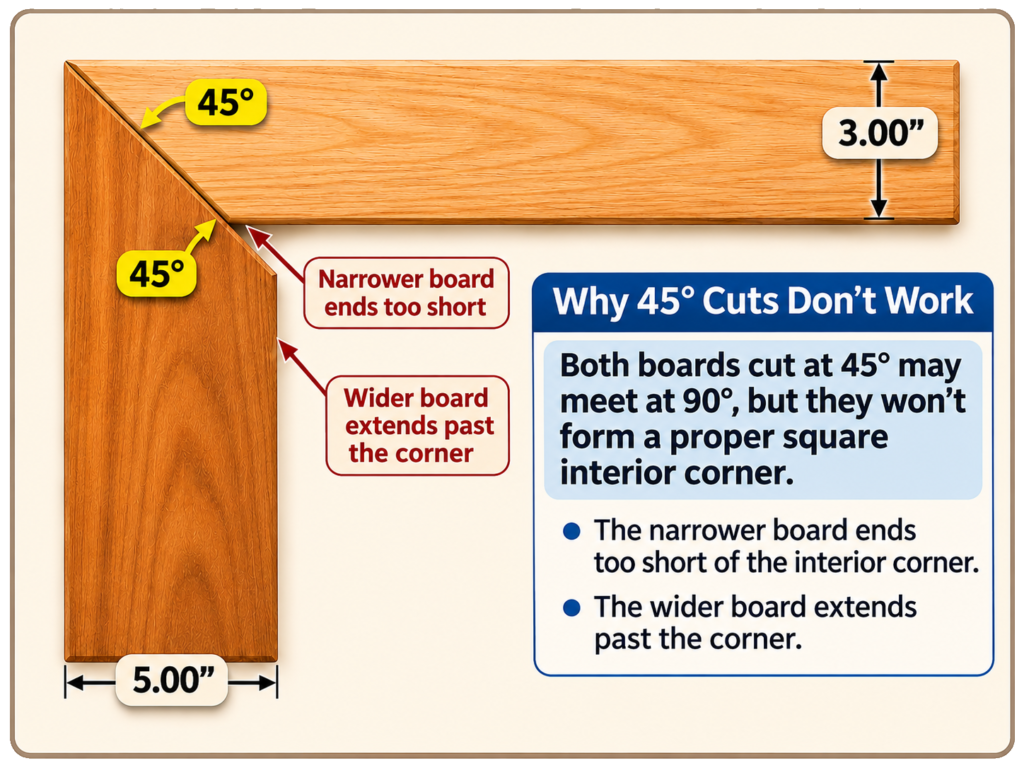
To make the joint fit correctly, the two boards need different cutting angles.
The narrower board requires a greater miter saw angle, while the wider board requires a smaller one.
So how do we determine those angles?
The Hard Way: Calculating Unequal Miter Angles
If you enjoy figuring things out mathematically, unequal miters are an interesting little woodworking problem.
The good news is that the mathematics isn’t particularly complicated once you understand the basic principle.
We’re going to use a trigonometric function called inverse tangent, commonly written as arctan or tan⁻¹.
Don’t let the name intimidate you. The function simply converts a ratio into an angle.
We’ll continue using our 3-inch and 5-inch boards meeting at a 90-degree corner.
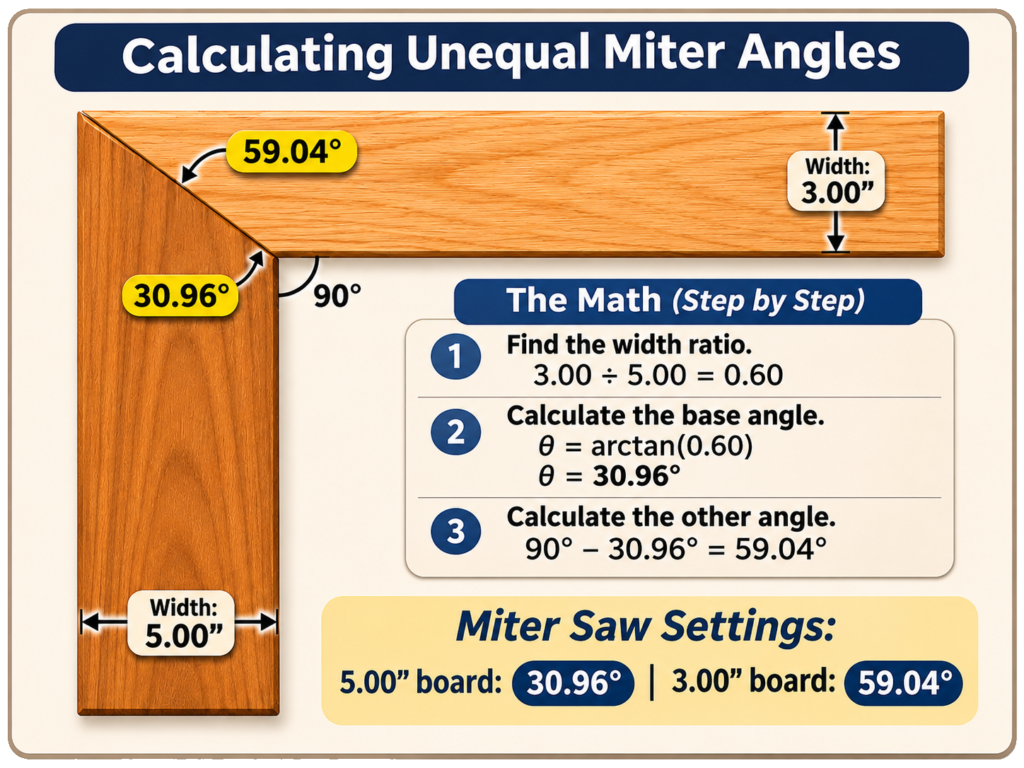
Step 1: Find the Ratio of the Board Widths
Start by dividing the narrower board’s width by the wider board’s width.
3 ÷ 5 = 0.60
This gives us a ratio of 0.60.
Notice that we haven’t calculated an angle yet. We simply know how the widths relate to one another.
Step 2: Calculate the First Angle Using Arctan
Now we need to convert our ratio into an angle.
The formula is:
Angle = arctan(3 ÷ 5)
Or, using the ratio we just calculated:
Angle = arctan(0.60)
On a scientific calculator set to degrees, enter 0.60 and use the inverse tangent function, often labeled tan⁻¹.
The result is:
30.96375653°
Rounded to two decimal places:
30.96°
That’s our first angle.
Step 3: Calculate the Second Angle
Because our finished joint is a 90-degree corner, the two complementary angles must add up to 90 degrees.
We already know one angle is approximately 30.96 degrees.
Subtract it from 90 degrees:
90° − 30.96° = 59.04°
Now we have both angles:
- 30.96 degrees
- 59.04 degrees
Together, they total 90 degrees.
Step 4: Determine Which Angle Belongs to Each Board
This is where it’s important to understand how miter saw angles are measured.
A standard miter saw reads zero degrees when the blade makes a square crosscut across the board.
The angle shown on the saw is measured away from that square-cut position.
For our example, the required miter saw settings are:
- Board A (3 inches wide): 59.04°
- Board B (5 inches wide): 30.96°
The narrower board gets the larger miter saw setting.
These settings are complementary to the angles measured between the miter line and the boards’ long edges. That’s why it’s important not to confuse the two ways of measuring an angle.
Step 5: Make the Cuts
Once you’ve calculated the angles, you can prepare to cut the boards.
However, there’s one more consideration.
Many standard miter saws have a maximum miter adjustment of approximately 45 degrees in one or both directions.
Our narrower board requires a 59.04-degree setting, which may exceed your saw’s capacity.
Depending on your equipment, you may need a properly designed jig, an auxiliary fixture, or another safe cutting method.
Always verify that your cutting setup can produce the required angle safely. Never force a cut beyond the manufacturer’s stated capacity.
It’s also a good idea to test your measurements on scrap material before cutting the final pieces.
And remember, these calculations assume your finished joint is exactly 90 degrees.
If you’re working with a different corner angle, the required cuts will change.
The Easy Way: Use the Unequal Miter Calculator
We’ve just worked through the mathematics required to join a 3-inch board to a 5-inch board at a 90-degree corner.
It isn’t especially difficult once you understand the process, but it’s probably more calculating than most woodworkers want to do every time they need to make an angled joint.
Fortunately, there’s an easier way.
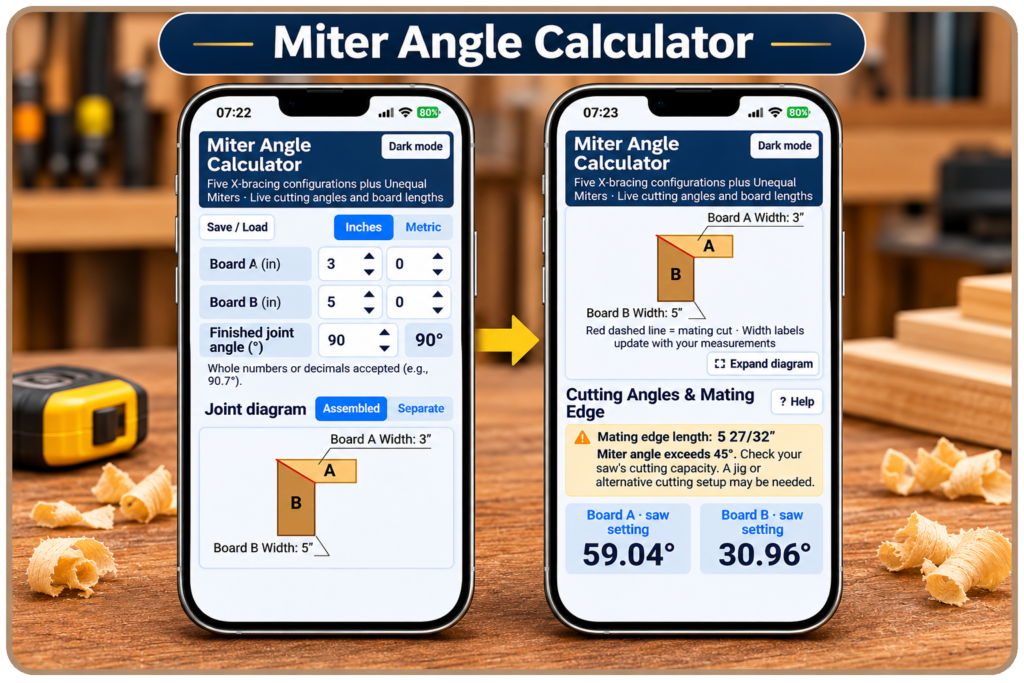
I developed the Miter Angle Calculator, which includes an Unequal Miter feature designed to calculate the cutting angles for boards of different widths.
Instead of working through the formulas manually, you simply enter your measurements.
For our example, enter:
- Board A width: 3 inches
- Board B width: 5 inches
- Finished joint angle: 90 degrees
The calculator immediately determines the required saw settings.
The results are:
- Board A: 59.04°
- Board B: 30.96°
Exactly the same results we calculated using trigonometry.
But instead of entering ratios, finding inverse tangents, and subtracting angles, the calculator does everything for you.
More Than Just Unequal Miters
The Miter Angle Calculator isn’t limited to joining boards of different widths.
It also includes five X-bracing configurations to help determine cutting angles and board lengths for diagonal bracing projects.
Whether you’re building gates, doors, decorative panels, or other woodworking projects involving angled cuts, having the calculations available can save time and reduce mistakes.
The calculator also provides visual diagrams, making it easier to understand how the pieces fit together.
Try the Unequal Miter Calculator for Free
The Unequal Miter Calculator is available through Ronnie’s Workshop FREE Members List.
When you join, you’ll get access to a growing collection of free woodworking calculators designed to make planning and building projects easier.
These tools help with measurements, angles, spacing, and other calculations that woodworkers regularly encounter.
There’s no charge to join.
Join Ronnie’s Workshop FREE Members List
After joining and confirming your email address, you can access the calculator library and begin using the tools.
Tips for Cutting Accurate Unequal Miters
Whether you calculate the angles yourself or use the calculator, a few good habits will help you get better results.
Measure the actual board widths. Don’t rely on nominal lumber sizes. For example, a standard 1×4 board is typically 3½ inches wide, not 4 inches. Using the wrong width will produce the wrong angles.
Check your saw’s accuracy. Even a small error in the cutting angle can leave a noticeable gap in a miter joint. Make sure your saw or jig is properly calibrated.
Make test cuts first. Before cutting expensive lumber, try the angles on scrap boards of the same widths. This lets you confirm the joint fits correctly.
Pay attention to the cutting line. Remember that the saw blade removes material. Cutting on the wrong side of your mark can change the finished dimensions.
Check the finished corner angle. Our example uses a 90-degree corner. If your project requires a different angle, calculate the cuts for that specific joint rather than assuming the same settings will work.
Taking a little extra time to verify your measurements can prevent wasted material and frustration.
Final Thoughts
Cutting unequal miters isn’t difficult once you understand why the angles need to be different.
When two boards of equal width meet at a 90-degree corner, two 45-degree cuts work perfectly.
But when the boards are different widths, the mating surfaces require different angles to produce a clean joint.
As we’ve seen, joining a 3-inch board to a 5-inch board at a 90-degree corner requires miter saw settings of 59.04° and 30.96°.
You can calculate those angles yourself using trigonometry, and understanding the mathematics is useful.
But when you’re in the workshop, sometimes you just want the correct measurements so you can get back to building.
That’s why I created the Miter Angle Calculator.